
7 Best Fiverr Alternatives for Freelancers and Small Businesses in 2026
Last Updated: July 22, 2026 | Reviewed by [Prof. Dr. Khalil Mudassar (Phd)]
Quick Answer
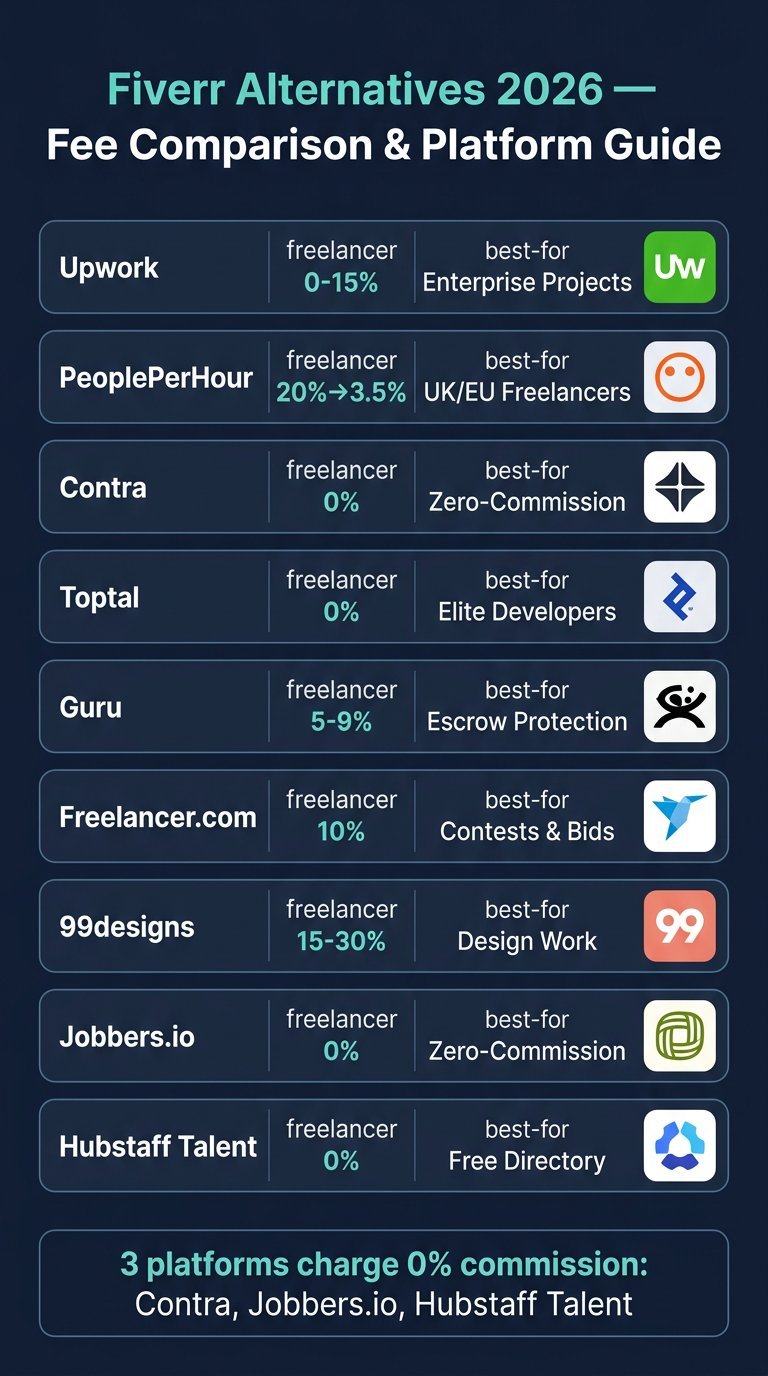
The best Fiverr alternatives in 2026 are Upwork for long-term professional contracts, Freelancer.com for competitive bidding and contests, PeoplePerHour for UK and European creative work, Guru for low-fee B2B services, Toptal for elite vetted talent, 99designs for graphic design projects, and Contra for zero-commission independent work. Fiverr charges a flat 20% commission on all earnings. Every alternative in this list charges less, with three platforms charging freelancers 0%. Choose based on your niche, experience level, and whether you prefer gig-based or proposal-based workflows.
Key Takeaways
- Fiverr charges a flat 20% commission on all earnings including tips. No volume discounts exist.
- Upwork charges a variable 0-15% service fee per contract (typically around 10%) since May 2025.
- Freelancer.com charges 10% or $5 minimum per project. It offers a unique contest feature for creatives.
- PeoplePerHour uses a tiered fee structure: 20% on first £350 per client, 7.5% up to £5,000, 3.5% above that.
- Guru charges 5-9% depending on membership tier. Its SafePay escrow system protects payments.
- Toptal charges freelancers 0% but takes a 30-50% markup on client-facing rates. Only the top 3% of applicants pass.
- 99designs uses a contest-based model for graphic design projects. Freelancer fees range from 15-30%.
- Contra charges 0% commission to both freelancers and clients. It uses a portfolio-first approach.
- Zero-commission platforms like Contra and Jobbers.io let freelancers keep 100% of earnings (paid proposal credits may apply).
- Most successful freelancers use 2-3 platforms simultaneously to diversify their client pipeline.
Why Look Beyond Fiverr
Fiverr dominates the gig marketplace with 3.1 million active buyers and $430.9 million in FY2025 revenue. But its structure creates real problems for freelancers who want to grow beyond small, one-off projects.
The Core Problem: Fiverr's 20% Flat Commission
Every dollar you earn on Fiverr loses 20 cents to the platform. No exceptions. No volume discounts. No tier reductions based on your seller level or earnings history. At $60,000 in annual earnings, you pay $12,000 in commission alone. Over a 10-year career at that rate, you lose $120,000 to platform fees.
Most alternatives charge less. Upwork's typical 10% saves you $6,000 per year at the same earnings level. Guru's 5-9% saves even more. Zero-commission platforms like Contra save the full 20%.
Other Limitations
- No hourly contracts: Fiverr only supports fixed-price gig packages. If your work requires hourly billing, Fiverr cannot accommodate it.
- Limited long-term relationships: Most Fiverr transactions are one-off. The average buyer spends $342 per year. Building recurring client revenue is difficult.
- 14-day payment holds: Standard sellers wait 14 days to access earnings. Top Rated and Pro sellers wait 7 days. Upwork releases funds in 5 days.
- Race-to-bottom pricing: Thousands of sellers compete in each category. Underpricing to win orders reduces your effective earnings further after the 20% cut.
- Small-order buyer fees: Fiverr charges buyers 5.5% plus a surcharge on lower-value orders. This makes inexpensive gigs costly for clients, reducing order frequency.
These limitations do not make Fiverr bad. They make Fiverr specialized. It excels for quick, standardized, low-to-medium-value creative tasks. But when your goals extend beyond that scope, alternatives serve you better.
Platform Comparison at a Glance
| Platform | Freelancer Fee | Client Fee | Best For | Payment Protection | Setup Time |
|---|---|---|---|---|---|
| Upwork | 0-15% variable (~10%) | Up to 7.99% + initiation fee | Long-term contracts, professional services | Escrow + time tracking | 2-3 hours |
| Freelancer.com | 10% or $5 minimum | 3% per milestone | Competitive bidding, creative contests | Milestone-based escrow | Immediate |
| PeoplePerHour | 3.5-20% tiered per client | 10% + £0.60 | UK/EU creative and tech work | Escrow with 14-day hold | 1-2 days |
| Guru | 5-9% membership-based | 2.9% (100% cashback on some methods) | B2B professional services | SafePay escrow | 1-2 days |
| Toptal | 0% to freelancer | 30-50% markup absorbed into rates | Elite developers, designers, finance experts | Full payment protection | 1-3 weeks (vetting) |
| 99designs | 15-30% (built into pricing) | 5-15% varies by project | Graphic design contests and projects | Guaranteed contest payments | 1-2 days |
| Contra | 0% | 0% (flat $29 per contract option) | Zero-commission independent work | Payment guarantee via Stripe | Minutes |
| Fiverr (baseline) | 20% flat | 5.5% + small-order surcharge | Quick, standardized creative tasks | Order-based escrow | 30 minutes |
1. Upwork: Best for Long-Term Professional Contracts
Upwork is the largest freelance marketplace by revenue ($787.8 million FY2025) and active client count (785,000). It serves 18 million registered freelancers across every professional category. If you want complex, ongoing projects with higher earning potential, Upwork is the strongest alternative to Fiverr.
How It Works
Upwork uses a proposal-based model. Clients post detailed project descriptions with budgets and timelines. You submit a proposal with a cover letter, portfolio samples, and bid amount. The client reviews proposals, interviews shortlisted candidates, and hires one. Contracts can be hourly with built-in time tracking or fixed-price with milestone-based delivery.
This structure differs fundamentally from Fiverr's gig model. On Fiverr, buyers find you. On Upwork, you find buyers. The active approach requires more effort but yields higher-value projects and deeper client relationships.
Fee Structure (Updated May 2025)
Upwork replaced its previous tiered fee system (20% on first $500 per client, 10% up to $10,000, 5% beyond that) in May 2025. The current system charges a variable 0-15% service fee per contract, determined by Upwork's algorithm based on skill category demand, market saturation, and project characteristics. The rate is disclosed when you submit a proposal and locked for that contract's duration.
Most freelancers report paying around 10%. High-demand skills like AI and machine learning may qualify for lower rates (0-5%). Oversaturated categories may face higher rates (10-15%).
Clients pay up to 7.99% (or 3% for eligible US ACH payments) plus a contract initiation fee of $0.99-$14.99 per new contract. Freelancers also pay $0.15 per Connect (the virtual currency required to submit proposals).
Key Advantages Over Fiverr
- Lower effective commission (approximately 10% vs. 20%).
- Hourly contracts with time tracking and payment protection.
- Milestone-based project management for complex work.
- Higher average project value ($800+ vs. Fiverr's $50-500).
- Long-term client relationships with recurring revenue. Clients average $5,129 per year.
- Faster payment release (5 days vs. 14 on Fiverr).
- Enterprise and corporate client access.
Key Disadvantages
- Proposal writing requires significant time and skill.
- Connects cost $0.15 each. Active freelancers spend $30-60 monthly on proposals.
- Steeper learning curve for new freelancers.
- Slower first-order timeline (2-8 weeks for beginners).
- 13.5% conversion fee if client hires you full-time off-platform within 2 years.
Best Fit
Choose Upwork if you offer custom, complex professional services (web development, data analytics, consulting, ongoing marketing) and want long-term client relationships with higher average project values. Avoid Upwork if you prefer passive client acquisition or sell standardized, quick-turnaround services.
2. Freelancer.com: Best for Competitive Bidding and Creative Contests
Freelancer.com is one of the oldest and largest freelance marketplaces with over 60 million registered users across 247 countries. It combines traditional project bidding with a unique contest feature that appeals to creative professionals.
How It Works
Freelancer.com offers two primary work models. The project bidding system lets clients post projects with descriptions and budgets. Freelancers submit bids with proposals and quotes. The client selects the best bid. The contest system lets clients create competitions where multiple freelancers submit work. The client picks the winner, who receives the prize money. Non-winning submissions are not compensated.
The contest feature is Freelancer.com's most distinctive offering. It works well for logo design, branding, illustration, and other creative projects where clients want to see multiple options before committing.
Fee Structure
Freelancers pay 10% or $5 minimum per project (whichever is greater). On a $50 project, the minimum $5 fee represents 10%. On a $500 project, the 10% fee is $50. Clients pay 3% per milestone payment.
Additional costs include project visibility upgrades ($9.99-$21.99 each) to attract higher-quality proposals. These optional costs compound for freelancers bidding on many projects.
Key Advantages Over Fiverr
- Lower commission (10% vs. 20%).
- Contest feature provides creative exposure and portfolio building.
- Hourly project option for ongoing work.
- Massive global reach across 247 countries and territories.
- Multiple payment options including PayPal and bank transfers.
Key Disadvantages
- High competition with dozens of bids per project.
- Inconsistent freelancer vetting. Quality varies widely.
- Contest model can result in unpaid work for non-winning designers.
- 3% per-milestone client fee compounds on phased projects.
- Variable customer support quality reported by users.
- Interface can feel cluttered compared to Fiverr's streamlined design.
Best Fit
Choose Freelancer.com if you want lower commission than Fiverr, access to creative contests, and a truly global client base. It works well for graphic designers, writers, and developers who thrive in competitive environments. Avoid it if you prefer curated, high-quality client matches or dislike unpaid contest participation.
3. PeoplePerHour: Best for UK and European Creative Work
PeoplePerHour (PPH) was founded in 2007 in the UK and has built a strong presence in the European freelance market. It combines Fiverr-style packaged services with Upwork-style custom proposals, making it versatile for freelancers who want both approaches.
How It Works
PPH offers two work models. Hourlies are pre-packaged fixed-price services similar to Fiverr gigs. Freelancers define the scope, price, and delivery time. Buyers purchase directly without bidding. Custom proposals let freelancers pitch tailored solutions to client project postings, similar to Upwork's proposal system.
This dual model gives freelancers flexibility. Sell standardized services through Hourlies for quick income. Submit custom proposals for larger, more complex projects. The platform works especially well for creative professionals: graphic designers, writers, video editors, and marketers.
Fee Structure
PeoplePerHour uses a tiered commission structure per client relationship:
- 20% on the first £350 earned per client
- 7.5% on earnings from £350.01 to £5,000 per client
- 3.5% on all earnings above £5,000 per client
This structure rewards long-term relationships. New clients cost 20% initially, matching Fiverr's rate. But as you build repeat business with the same client, your commission drops significantly. At the 3.5% tier, PeoplePerHour becomes one of the cheapest platforms available.
Clients pay a 10% fee plus £0.60 on payments made via PayPal or credit card.
Always verify current fee thresholds on PeoplePerHour's official fees page.
Key Advantages Over Fiverr
- Commission drops to 3.5% with established clients. Fiverr stays at 20% forever.
- Dual model: Hourlies for quick sales plus custom proposals for larger projects.
- Strong UK and European client base with local currency pricing.
- Escrow protection with deposit required before work begins.
- 24/7 customer support and mediation services for disputes.
Key Disadvantages
- 20% commission on new clients matches Fiverr's rate until you build tenure.
- Smaller global reach compared to Fiverr and Upwork.
- 14-day payment hold period for standard withdrawals.
- Less effective for freelancers targeting US or Asian markets.
- GBP-denominated thresholds create complexity for non-UK freelancers.
Best Fit
Choose PeoplePerHour if you are based in the UK or Europe, work in creative or technical services, and value long-term client relationships that reduce commission over time. Avoid it if your primary market is the US or Asia, or if you prefer purely passive client acquisition.
4. Guru: Best for Low-Fee B2B Professional Services
Guru has operated since 1998, making it one of the oldest freelance platforms. It specializes in business-to-business professional services: programming, business consulting, engineering, legal support, and administrative work. Its fee structure is membership-based, giving freelancers control over their commission rate.
How It Works
Guru uses a proposal-based model similar to Upwork. Clients post projects. Freelancers submit proposals with quotes and timelines. The client selects a freelancer and funds the project through Guru's SafePay escrow system. Work is managed through Guru's WorkRoom collaboration space, which tracks messages, files, milestones, and payments.
Fee Structure
Guru's commission depends on your membership tier:
| Membership | Cost | Commission on Earnings | Job Bids Per Year |
|---|---|---|---|
| Basic (Free) | Free | 9% | 120 bids/year |
| Pro | $39.95/month (annual) or $49.95/month | 5% (lower with higher tiers) | Unlimited |
| Elite | Varies (verify current pricing) | 5% or lower | Unlimited + priority features |
Even at the Basic tier, Guru charges 9% versus Fiverr's 20%. At the Pro tier, the commission drops to 5%. The membership cost offsets the commission savings, so calculate whether your earnings justify the subscription.
Clients pay 2.9% per invoice. Guru offers 100% cashback on this fee when clients pay via eCheck, physical check, or wire transfer, effectively reducing client costs to zero for those payment methods.
Key Advantages Over Fiverr
- Significantly lower commission (5-9% vs. 20%).
- SafePay escrow system protects both freelancers and clients.
- WorkRoom collaboration tools for project management.
- Multiple payment options with flexible terms.
- 100% cashback on client handling fees for certain payment methods.
Key Disadvantages
- Smaller talent pool and client base than Fiverr or Upwork.
- Interface feels dated compared to modern platforms.
- Pro membership costs $39.95-$49.95 monthly. You must earn enough to justify the subscription.
- Lower volume of available projects compared to larger marketplaces.
- Limited brand recognition among new freelancers and clients.
Best Fit
Choose Guru if you offer B2B professional services, value low commission rates, and want structured collaboration tools like WorkRoom and SafePay. The Basic tier works for freelancers earning under $1,000 monthly. The Pro tier becomes cost-effective at higher earnings volumes. Avoid Guru if you need a large client pool or prefer modern interface design.
5. Toptal: Best for Elite Vetted Talent
Toptal is not a marketplace. It is an exclusive network that accepts only the top 3% of freelance applicants in development, design, project management, and finance. The screening process is rigorous. The clients are premium. The rates are high. This platform serves a fundamentally different market than Fiverr.
How It Works
Toptal does not let clients browse freelancer listings. Instead, clients submit project requirements. Toptal's matching team selects appropriate freelancers from its vetted network and presents candidates to the client. The client reviews profiles and interviews selected freelancers before hiring. This concierge-style matching reduces client screening effort significantly.
The Screening Process
Toptal's screening involves multiple stages:
- Application review: Candidates submit detailed applications covering work experience, skills, and portfolio.
- Skills assessment: Candidates take comprehensive language and skill tests evaluated by Toptal experts.
- Live interview: Candidates participate in a real-time interview with a Toptal recruiter covering technical depth and communication ability.
- Project simulation: Candidates complete real-world project tasks to demonstrate problem-solving skills and delivery quality.
The entire process takes 1-3 weeks. Approximately 97% of applicants are rejected at some stage. This exclusivity ensures that every freelancer in Toptal's network meets a high standard.
Fee Structure
Toptal charges freelancers 0% commission. You negotiate your hourly rate directly with the client. However, Toptal adds a significant markup on the client-facing rate. If your target rate is $80 per hour, the client may pay $120-$160 per hour. The difference represents Toptal's revenue. This markup model means freelancers earn their full negotiated rate while clients pay premium pricing.
Clients pay a $79 monthly subscription fee plus project rates that include Toptal's markup. A no-risk trial period lets clients test a freelancer before committing to a longer engagement.
Key Advantages Over Fiverr
- 0% freelancer commission. You keep your full negotiated rate.
- Premium clients including Fortune 500 companies and major tech firms.
- Rigorous vetting creates trust and reduces client screening time.
- Average developer rates range from $60-$200+ per hour. Far above Fiverr's typical range.
- Concierge matching eliminates the need to submit proposals or optimize listings.
- Access to business connections at companies like Airbnb and Bridgewater Associates.
Key Disadvantages
- Only 3% of applicants pass screening. Most freelancers cannot join.
- Premium client pricing may limit project volume for budget-conscious clients.
- Limited service categories. Only covers development, design, finance, and project management.
- 1-3 week vetting process before you can start working.
- Not suitable for small, one-off tasks or standardized services.
Best Fit
Choose Toptal if you are a senior-level professional with exceptional skills in development, design, or finance, and you want premium rates with zero commission. Avoid it if you are a beginner, lack a strong portfolio, or sell standardized gig-style services that do not require elite expertise.
6. 99designs: Best for Graphic Design Projects
99designs is a design-only platform. It does not cover development, writing, marketing, or any other category. This specialization creates a focused community of over one million designers and clients who need graphic work. If you are a graphic designer, 99designs offers a targeted alternative to Fiverr's broader marketplace.
How It Works
99designs offers two primary models. Design contests let clients describe their project (logo, packaging, business card, website) and set a prize amount. Multiple designers submit entries. The client reviews all submissions and picks a winner who receives the prize. Non-winning designers do not receive payment, though they gain portfolio exposure.
1-to-1 Projects let clients hire a specific designer directly for custom work. This model functions like a standard freelance engagement with negotiated scope and pricing.
Fee Structure
For contest winnings and direct projects, 99designs charges freelancers approximately 15-30%, which is built into the pricing structure. The exact rate varies by designer level and project type. Clients pay a 5-15% fee depending on the project tier.
Contest pricing starts at $299 for Bronze-tier logo contests and increases for higher tiers with more designer entries and premium features. These fees are paid by the client, not deducted from the designer's prize.
Key Advantages Over Fiverr
- Design-focused community attracts clients specifically seeking graphic work.
- Contest model lets you showcase creativity and build your portfolio with multiple submissions.
- Collaboration tools including messaging and video chat for clear client feedback.
- Designers categorized at entry, mid, and expert levels for appropriate project matching.
- Strong brand recognition in the design community.
Key Disadvantages
- Contest model involves unpaid work for non-winning submissions.
- 15-30% freelancer fee can be higher than Fiverr's 20% at certain tiers.
- Only covers graphic design. No categories for development, writing, or other services.
- Small projects may not justify the contest format or pricing tiers.
- Competition within contests can be intense with many designers submitting.
Best Fit
Choose 99designs if you are a graphic designer seeking a specialized community, portfolio exposure through contests, and clients who value design quality. The contest model works best for branding and logo projects. Avoid it if you offer non-design services, dislike unpaid contest participation, or prefer guaranteed payment for every submission.
7. Contra: Best for Zero-Commission Independent Work
Contra represents the emerging zero-commission model in freelance platforms. It charges freelancers 0% and clients 0% on project earnings. Instead of extracting commission from every transaction, Contra monetizes through optional features and a flat $29 per contract fee option.
How It Works
Contra uses a portfolio-first approach. You build a profile showcasing your work, skills, and experience. Clients browse portfolios and reach out directly, or Contra's AI-powered matching suggests relevant projects. Communication, contracts, and payments happen within the platform, but Contra takes no percentage of your earnings.
The model resembles having your own professional website with built-in client discovery, contract management, and payment processing. You control your rates, terms, and deliverables without platform interference.
Fee Structure
0% commission on all completed project earnings for both freelancers and clients. Contra offers an optional flat fee of $29 per contract for enhanced features including priority matching and enhanced contract tools. This flat fee is significantly cheaper than percentage-based commissions on high-value projects.
Key Advantages Over Fiverr
- 0% commission. You keep 100% of your negotiated rate.
- Portfolio-first approach puts your work at the center of client discovery.
- AI-powered matching suggests relevant projects based on your skills.
- Direct client relationships without platform intermediation on pricing.
- No payment holds. You receive funds directly through Stripe integration.
- Flat $29 per contract option is cheaper than 20% on any project over $145.
Key Disadvantages
- Smaller client base than Fiverr, Upwork, or Freelancer.com.
- Newer platform with less brand recognition among clients.
- No mandatory escrow system. Payment protection relies on Stripe's guarantee.
- No built-in dispute resolution beyond direct negotiation.
- Requires more business maturity to manage contracts independently.
- Discovery is less passive than Fiverr. You must maintain an active portfolio.
Best Fit
Choose Contra if you want to keep 100% of your earnings, have an established portfolio, and prefer direct client relationships without commission extraction. It works best for experienced freelancers earning $1,000+ per project where the commission savings are substantial. Avoid it if you need a large passive client pipeline, built-in escrow protection, or are just starting without a portfolio.
Bonus: Two Zero-Commission Alternatives Worth Knowing
Jobbers.io
Jobbers.io charges 0% commission on completed project earnings for both freelancers and clients. It operates in 150+ countries across 200+ service categories, supporting English, French, and Arabic. The platform uses paid proposal credits for bid submission rather than commission on earnings. At $60,000 in annual earnings, switching from Fiverr's 20% to Jobbers.io's 0% saves approximately $12,000 per year in commission alone.
Limitations include a smaller client base than established platforms, no mandatory escrow system, and no platform-provided dispute arbitration. Freelancers must manage contracts and payment protection independently. Verify current proposal credit pricing at jobbers.io.
Hubstaff Talent
Hubstaff Talent charges 0% commission to both freelancers and clients. It functions as a freelancer directory rather than a managed marketplace. Clients browse profiles, contact freelancers directly, and arrange work independently. Hubstaff Talent serves as lead generation for its parent company's paid time-tracking software.
Limitations include passive discovery (low volume), no built-in escrow, and limited client base compared to major platforms. It works well for remote developers and marketers who already use time-tracking tools and want free marketplace access.
How to Choose the Right Platform for Your Needs
| Your Situation | Recommended Platform | Why |
|---|---|---|
| Beginner with no portfolio | Fiverr or Freelancer.com | Low entry barriers. Fiverr's gig model lets you start immediately. Freelancer.com offers contest exposure. |
| Intermediate seeking long-term clients | Upwork or PeoplePerHour | Higher project values. Upwork offers enterprise access. PeoplePerHour's fees decrease with repeat clients. |
| Elite professional with strong portfolio | Toptal or Contra | Toptal for premium rates with concierge matching. Contra for 0% commission and direct relationships. |
| Graphic designer | 99designs or PeoplePerHour | 99designs for contest exposure and design-focused clients. PeoplePerHour for ongoing design relationships. |
| B2B service provider | Guru or Upwork | Guru's low commission and SafePay escrow. Upwork's larger client pool for professional services. |
| UK or Europe-based freelancer | PeoplePerHour or Malt | Strong local market presence. GBP/EUR pricing. Decreasing commission with tenure. |
| Fee-maximization priority | Contra or Jobbers.io | 0% commission keeps 100% of earnings. Trade-off: smaller client base and less built-in protection. |
| Developer or technical specialist | Toptal, Arc.dev, or Upwork | Toptal/Arc for vetted premium work. Upwork for volume and variety. |
The Hybrid Strategy: Using Multiple Platforms
Most successful freelancers do not rely on one platform. They diversify across 2-3 marketplaces to maximize reach and reduce dependency on any single algorithm or policy change.
Recommended Approach
- Month 1-6: Focus on Fiverr for quick reviews and portfolio building. The low barrier to entry gets you earning faster.
- Month 6+: Open an Upwork or PeoplePerHour profile for larger projects and recurring clients.
- Year 2+: Add Contra or Jobbers.io for established client relationships at 0% commission.
- Ongoing: Use Fiverr for standardized quick orders. Use Upwork for complex, high-value contracts. Use Contra for direct relationships that avoid commission.
Important Platform Rules
Both Fiverr and Upwork restrict soliciting clients to leave their marketplace. Upwork's 13.5% conversion fee applies within 2 years. Fiverr prohibits sharing direct contact information in messages. However, if a client discovers you independently through your personal website, there is no restriction on working directly. Building your own website creates an off-platform pipeline that avoids all platform commissions.
Common Mistakes When Switching Platforms
- Abandoning Fiverr entirely. Fiverr still generates passive inbound orders. Keep it active while building presence on alternatives.
- Ignoring total cost including Connects and subscriptions. Upwork's 10% commission plus $30-60 monthly Connects costs equals approximately 11% effective rate. Guru's 5% commission plus $39.95 monthly subscription requires minimum earnings to justify.
- Expecting immediate results on new platforms. Upwork takes 2-8 weeks for first orders. Toptal takes 1-3 weeks for vetting. Give each platform adequate time.
- Choosing based only on commission rate. A 0% platform with no clients generates $0. A 20% platform with 3.1 million buyers generates revenue. Factor in client volume alongside fees.
- Not optimizing your profile for each platform's model. Fiverr rewards gig SEO. Upwork rewards proposal quality. Contra rewards portfolio presentation. Tailor your approach to each platform's discovery mechanism.
- Over-investing in one platform. Algorithm changes, policy updates, and account issues can disrupt your income overnight. Diversify.
- Ignoring zero-commission alternatives for established clients. Once you have a trusted client relationship, moving them to Contra or Jobbers.io eliminates ongoing commission on all future work.
- Not calculating break-even on paid memberships. Guru's $39.95/month Pro membership saves 4% commission (9% vs 5%). At $1,000 monthly earnings, that saves $40, barely covering the membership cost. At $5,000 monthly, it saves $200, making membership clearly worthwhile.
Expert Tips for Success Across Platforms
- Niche down on every platform. "WordPress speed optimization for WooCommerce" beats "web developer" in competition and conversion.
- Use Fiverr for passive inbound orders. Use Upwork for active high-value pursuits. Use zero-commission platforms for established relationships.
- Track your effective hourly rate across each platform, including all fees, subscriptions, Connects, and payment holds.
- Build your own website for off-platform client acquisition. This avoids all marketplace commissions entirely.
- On PeoplePerHour, prioritize repeat business with the same clients. Commission drops from 20% to 3.5% as you build tenure.
- On Upwork, invest in proposal quality. Each proposal costs Connects. Make every submission targeted and personalized.
- On Guru, calculate whether the Pro membership saves you money based on your current and projected earnings volume.
- On Toptal, prepare a strong portfolio and practice the screening stages. The acceptance rate is only 3%.
- On 99designs, participate in contests for portfolio building even if you do not win. Exposure matters in design.
- On Contra, invest time in your portfolio presentation. Discovery is portfolio-driven, not algorithm-driven.
- Monitor all platforms' policy changes quarterly. Fee structures, features, and terms evolve regularly.
- Maintain a 100% response rate on every platform. Fast communication improves visibility and trust universally.
- Consider transitioning repeat clients to zero-commission platforms after the initial discovery relationship. This saves 10-20% on all future work with that client.
- Never share direct contact information in platform messages. Both Fiverr and Upwork prohibit this in their Terms of Service.
Frequently Asked Questions
Which Fiverr alternative has the lowest fees?
Contra and Jobbers.io charge 0% commission on freelancer earnings. Toptal charges freelancers 0% but adds a markup to client rates. Among commission-based platforms, Guru charges the lowest at 5-9% depending on membership tier. PeoplePerHour drops to 3.5% for established client relationships.
Is Upwork better than Fiverr?
It depends on your goals. Upwork offers lower fees (approximately 10% vs. 20%), higher project values ($800+ average vs. $50-500), and long-term client relationships. Fiverr offers easier setup, passive client acquisition, and faster first orders. Many freelancers use both platforms simultaneously for different project types.
Can I use multiple platforms at the same time?
Yes. Most successful freelancers maintain profiles on 2-3 platforms. Use Fiverr for quick standardized orders, Upwork for complex professional work, and a zero-commission platform for established client relationships. Diversifying reduces dependency on any single marketplace.
What happened to Upwork's fee structure?
In May 2025, Upwork replaced its tiered commission (20% on first $500 per client, 10% up to $10,000, 5% beyond) with a variable 0-15% fee determined per contract. The rate is disclosed at proposal submission and locked for that contract. Most freelancers report paying around 10%.
Is PeoplePerHour only for UK freelancers?
No. PeoplePerHour accepts freelancers worldwide. However, its strongest client base is in the UK and Europe. Freelancers targeting those markets benefit most. The GBP-denominated fee thresholds create some complexity for non-UK earners.
How does Toptal's screening process work?
Toptal screens applicants through four stages: application review, comprehensive skills testing, live interview with a recruiter, and real-world project simulation. Only approximately 3% of applicants pass all stages. The process takes 1-3 weeks.
Is the 99designs contest model fair to designers?
Contest winners receive the full prize amount. Non-winning designers receive portfolio exposure but no payment. This model is debated in the design community. If you dislike unpaid work, use 99designs' 1-to-1 Projects feature instead, which functions like standard freelance engagements.
Can I really keep 100% of my earnings on Contra?
Yes. Contra charges 0% commission on completed project earnings. Optional features include a flat $29 per contract fee for enhanced matching and tools. On a $500 project, you pay either $0 or $29 on Contra versus $100 on Fiverr. The savings increase with project size.
What is Guru's SafePay system?
SafePay is Guru's escrow system. Clients deposit funds into SafePay before work begins. Freelancers deliver the work. The client reviews and approves. SafePay then releases payment to the freelancer. This protects both parties from non-payment and non-delivery disputes.
Which platform is best for beginners?
Fiverr remains the easiest for beginners due to its gig-based model, low setup time, and passive client acquisition. Freelancer.com is also accessible. Upwork requires more effort for first orders. Contra and Toptal are better suited for experienced freelancers with established portfolios.
Are platform fees tax deductible?
In most jurisdictions, platform commissions are deductible as business expenses. A deduction offsets a fraction of the cost but does not eliminate it. Consult a tax professional for guidance specific to your jurisdiction. This is general information, not tax advice.
What is the 13.5% Upwork conversion fee?
Upwork charges a 13.5% conversion fee on a freelancer's projected first-year earnings if a client hires them full-time outside the platform within two years of the initial Upwork contract. This fee applies to the freelancer, not the client.
Should I abandon Fiverr when switching platforms?
No. Keep your Fiverr gigs active. They generate passive inbound orders that complement your work on other platforms. The hybrid strategy maximizes your total income by leveraging each platform's unique strengths.
Conclusion and Next Steps
Fiverr is not the only option. Its 20% flat commission, limited project scope, and transactional client model create real constraints for freelancers seeking growth. The seven alternatives in this guide each address different needs with lower fees, better client relationships, or specialized communities.
Upwork serves professional freelancers seeking long-term contracts and higher project values. Freelancer.com offers competitive bidding and creative contests. PeoplePerHour rewards European creatives with decreasing commission. Guru provides low-fee B2B services with SafePay protection. Toptal connects elite talent with premium clients. 99designs focuses exclusively on graphic design. Contra eliminates commission entirely.
The commission savings alone justify diversifying. At $60,000 in annual earnings, Fiverr costs $12,000. Upwork costs approximately $6,000. Contra costs $0. That $6,000-$12,000 difference compounds into $60,000-$120,000 over a decade.
Here is your action plan:
- Keep your Fiverr gigs active for passive inbound orders.
- Create an Upwork profile for complex, high-value projects.
- Open a PeoplePerHour account if you target UK or European clients.
- Consider Guru if you offer B2B professional services and want lower commission.
- Apply to Toptal if you have elite-level skills and a strong portfolio.
- Join Contra for zero-commission direct client relationships.
- Explore 99designs if you are a graphic designer seeking contest exposure.
- Calculate your effective rate on each platform including all fees and costs.
- Build your own website for off-platform client acquisition over time.
- Diversify across 2-3 platforms to reduce dependency on any single marketplace.
The best freelancers do not pick one platform. They build a portfolio strategy that maximizes reach, minimizes fees, and diversifies risk. Start by creating profiles on two alternatives today. Your next high-value client may be searching on a platform you have not yet joined.
Disclaimer: This article is for informational purposes only and does not constitute professional, legal, or financial advice. Platform fees, policies, and features change regularly. Always verify current terms on each platform's official website before making decisions. Some platforms mentioned may have affiliate relationships with the publisher.
